Sql Server Generate Unique Table Name : Sql Commands Tutorial List Of Sql Commands With Example Edureka / Column1, column2 the columns that you wish to create in the table.
Sql Server Generate Unique Table Name : Sql Commands Tutorial List Of Sql Commands With Example Edureka / Column1, column2 the columns that you wish to create in the table.. Temporary tables and constraint names. By using the newid or newsequentialid functions.; If you got errors because of two processes running simultaneousely it was due to something else. The following script is for the creation of all primary keys and unique constraints in the sql server database: Sql server already adds that random number to the temp table name behind the covers, so you do not need to add it yourself.
By converting from a string constant in the form. Erland sommarskog, sql server mvp, esquel@sommarskog.se. By using the newid or newsequentialid functions.; The following script is for the creation of all primary keys and unique constraints in the sql server database: If the table does not exist already, a message is printed in the sql server management studio messages tab indicating the table is not available to drop.
Working With Identity Column After Table Creation In Sql Server from csharpcorner-mindcrackerinc.netdna-ssl.com Regarding the desire to name the constraints in order to be in line with naming conventions (as stated in a comment on the question): If the table does not exist already, a message is printed in the sql server management studio messages tab indicating the table is not available to drop. By using the newid or newsequentialid functions.; However, the names of constraints are stored in the metadata of tempdb and can produce duplicate name errors. 1505 the create unique index statement terminated because a duplicate key was found for the object name and the index name. Create unique index name_unique on dataflair_employee (name_emp); Custom generated id with sql server. Uc_col_n the columns that make up the unique constraint.
While it wouldn't hurt anything to use sp_rename (as pointed out in @peter's answer), it would just be a superficial change.one of the main reasons to have a naming convention is for maintenance, so that if you need to alter or drop the object later, you won't.
However, you can have many unique constraints per table, but only one primary key constraint per table. A guid is guaranteed to be unique across tables, databases, and even servers. Declare @schemaname varchar(100) declare @tablename varchar(256) declare @indexname varchar(256. The second example is a table used for a magazine publication. Temporary tables and constraint names. However, the names of constraints are stored in the metadata of tempdb and can produce duplicate name errors. If sequence values in a table are required to be unique throughout a group of tables, create triggers to prevent duplicates caused by update statements or sequence number cycling. This column is useful for. Copy this script and close the table designer window without saving it. Name varchar(20) not null, qty int not. Column1, column2 the columns that you wish to create in the table. The following script is for the creation of all primary keys and unique constraints in the sql server database: Create a unique nonclustered index.
Generate a million first and last names in the first example, we will use the dimcustomer table from the adventureworksdw database mentioned in the requirements. Using sql server management studio to create a unique index by using the table designer in object explorer, expand the database that contains the table on which you want to create a unique index. Query select schema_name(t.schema_id) + '.' + t.name as table_view, case when t.type = 'u' then 'table' when t.type = 'v' then 'view' end as object_type, case when c.type = 'pk' then 'primary key' when c.type = 'uq. Id primary example i want my customers table reading area code like this: Custom generated id with sql server.
Ms Sql Server Create Index from razorsql.com 1505 the create unique index statement terminated because a duplicate key was found for the object name and the index name. This is a unique identifier for the temporary table. A globally unique identifier or guid is a broader version of this type of id numbers. This table contains 18,000 rows. Create table testindex (id int identity, name nvarchar(100)) create unique clustered index myindex on testindex(id) now i run the following query: Copy this script and close the table designer window without saving it. Local temporary tables are isolated in the scope of current session regardless its name. Both the unique and primary key constraints provide a guarantee for uniqueness for a column or set of columns.
The name of the table that you wish to create.
The following example creates a unique nonclustered index on the name column of the production.unitmeasure table in the adventureworks2012 database. If sql server agent service is running already, just skip this step. You can of course use a larger (bigint) if the table might need more than 2,147,483,647 rows. I modified the table name to have an appropriate name for our demo. Temporary tables are invisible to other connections. We use the generated script to create the table and unique constraint in sql server. You could use a temporary table. We will use a cross join to generate all the possible combinations of names and last names. Both the unique and primary key constraints provide a guarantee for uniqueness for a column or set of columns. The name of the table that you wish to create. Custom generated id with sql server. Local temporary tables are isolated in the scope of current session regardless its name. If you got errors because of two processes running simultaneousely it was due to something else.
The following example creates a unique nonclustered index on the name column of the production.unitmeasure table in the adventureworks2012 database. However, the names of constraints are stored in the metadata of tempdb and can produce duplicate name errors. Sql server already adds that random number to the temp table name behind the covers, so you do not need to add it yourself. Because multiple database connections can create temporary tables with the same name, sql server automatically appends this unique number at the end of the temporary table name to differentiate between the temporary tables. Actually, you should define the constraint name while creating the table.
Create Unique Key On Table In Sql Server Sqlskull from i1.wp.com I modified the table name to have an appropriate name for our demo. A globally unique identifier or guid is a broader version of this type of id numbers. Query select schema_name(t.schema_id) + '.' + t.name as table_view, case when t.type = 'u' then 'table' when t.type = 'v' then 'view' end as object_type, case when c.type = 'pk' then 'primary key' when c.type = 'uq. The following script is for the creation of all primary keys and unique constraints in the sql server database: Temporary tables are invisible to other connections. While it wouldn't hurt anything to use sp_rename (as pointed out in @peter's answer), it would just be a superficial change.one of the main reasons to have a naming convention is for maintenance, so that if you need to alter or drop the object later, you won't. The table has one column named rand_digit with a tinyint data type. However, the names of constraints are stored in the metadata of tempdb and can produce duplicate name errors.
Query select schema_name(t.schema_id) + '.' + t.name as table_view, case when t.type = 'u' then 'table' when t.type = 'v' then 'view' end as object_type, case when c.type = 'pk' then 'primary key' when c.type = 'uq.
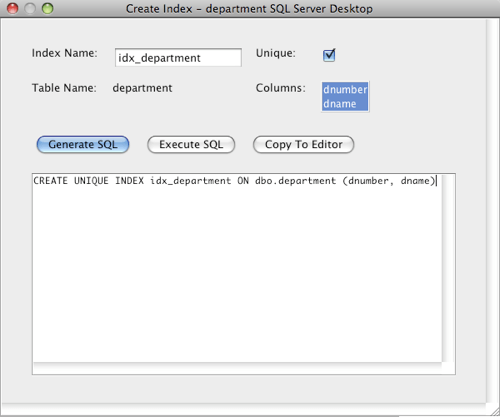
In general tab specify the name and the owner for the job. Constraint_name the name of the unique constraint. Column1, column2 the columns that you wish to create in the table. Name varchar(20) not null, qty int not. Next, a create table statement creates a fresh copy of rand_digits. The new job window is opened. Creating index over multiple columns in sql sometimes our columns contain duplicate or repetitive data, due to which the indexing is also duplicate and repetitive. Create unique index name_unique on dataflair_employee (name_emp); Query select schema_name(t.schema_id) as schema_name, t.name as table_name, t.create_date, t.modify_date from sys.tables t order by schema_name, table_name; Using sql server management studio to create a unique index by using the table designer in object explorer, expand the database that contains the table on which you want to create a unique index. The index will enforce uniqueness on the data inserted into the name column. Regarding the desire to name the constraints in order to be in line with naming conventions (as stated in a comment on the question): If sql server agent service is running already, just skip this step.



Comments
Post a Comment